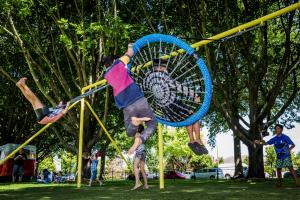

The Hastings District is home to more than 55 hectares of sports fields, 185 hectares of reserves, 160 hectares of domains, 10 hectares of gardens and shrub beds and some 8000 trees. Read about some of the main parks and gardens the Hastings District has on offer.
Accessible via Tomoana Rd, Cornwall Rd and Roberts St in Hastings, Cornwall Park features the serene Osmanthus Chinese Garden (see below) and spreads over eight hectares in an English village green environment.
It has a variety of colourful gardens and trees and is a favourite picnic spot. Collections of azaleas, camellias and roses have been added to the mature trees, which date back to the 1920's when the park was established.
Sit in the shade on a warm summer's day and watch a game of cricket, or take a walk around the park's formal gardens, aviary, and a display house crammed with colourful exotics.

Swing sets are an essential part of nearly every playground, but for some children it's not quite as simple as climbing on and seeing how high they can go.
The Variety Liberty Swing was installed at Cornwall Park in Hastings in 2005, and allows children in wheelchairs to enjoy the same tummy-fluttering fun as their friends, wheelchair and all.
The project was a joint venture between Hastings District Council and Variety, which gifted the $25,000 swing to the city from Gold Heart Appeal funds. The Council provided funds to install the swing, the safety enclosure and safety matting.
A fold-down ramp allows easy access for those on wheels, and the wheelchair is then locked firmly into place. A moulded plastic seat and harness allow children with other disabilities, who do not use wheelchairs but cannot use regular swings, to join in the fun.
The swing is kept locked to prevent vandalism, but you can obtain a key from Community Services by visiting the third floor of the Hastings District Council's main buildings in Lyndon Road, Hastings.
This traditional Chinese garden was established at Cornwall Park to commemorate Hastings' 15th anniversary of the sister city relationship with Guilin in 1996.
The garden was designed along lines traditional to Southern China by Guilin landscape designer Mr Zhao Jian.
At the main entrance, visitors to the garden pass through a moongate, which is a traditional symbol of unity, family and the nation. The circle of the moongate frames a large rock, which originated from Taihu Lake near Shanghai.
The garden takes its name from the Osmanthus family of plants, including highly scented shrubs and ground covers, which have been extensively planted throughout, along with group plantings of pine trees and bamboo.
At the heart of the garden is a large pond and pavilions at its edge. It is spanned by the curved Friendship Bridge across one end and by the Crooked Bridge across the other. The garden is a skilful combination of Chinese and New Zealand elements and plants. As such it could be seen as a perfect symbol of the Hastings-Guilin link.
Chinese gardens are rich in evocative symbolism. This is a dimension and a purpose more often found in ancient gardens, strange and unfamiliar to those of us used to modern western gardens that are dominated by function and the display of plant varieties. This garden is a giant Chinese puzzle designed to involve the viewer's imagination.
On Lyndhurst Road and Frimley Road in Hastings, Frimley Park has a well-known rose garden with more than 5,500 roses.
It was given to the people of Hastings by the Williams family in 1951, and was formerly the grounds for the family's homestead which burned down in 1950.
The park itself is an 'Old English' style park, and includes many beautiful and rare trees, planted by the Williams family.
It is also home to a Necklace Poplar which is the largest deciduous tree in a park setting in the Southern Hemisphere.
The Aquatic centre in the park has an Olympic size swimming pool, diving, learners and paddling pools, plus a picnic area.
Situated on State Highway 5 four kms up the Napier Taupo Road, Eskdale Park is seven hectares in size, half of which is mature trees offering shade to the playground and picnic areas.
The Esk River is on one side of the park and, being no more than knee deep, provides a great paddling area for young children.
There is plenty of room for a game of soccer or cricket on the wicket. Two rest rooms mean the park can accommodate large numbers and many company, school or social clubs have their annual picnics there.

Situated on Pufflet Road in Havelock North, Keirunga Gardens is the cultural centre for the district, having a large centre that caters as the workshop for arts groups.
The reserve area covers six hectares and is also the home for the Havelock North Live Steamers who have developed an extensive railway with bridges, viaducts and tunnels for their miniature steam trains.
The area is planted with mature oak trees which shade walkways leading you through the quiet valley. The areas under the trees have been extensively planted with bulbs to provide spring colour.
The focus to Keirunga Gardens is Keirunga Homestead, a restored period homestead dating from the early 20th century. In 2007 a refurbishment of the exterior was completed in keeping with the original intentions of the architect.
The gardens also have a recently installed playground (2006) and sculptures by Haumoana artist Peni Edwards. The "Paintbrush Garden" sculptures were completed in 2007.
For more information on the Keirunga Park Railway, including profiles, photos and opening hours, visit the Havelock North Live Steamers website: www.keirungaparkrailway.org.nz
For more information about Keirunga Gardens, you can visit the Keirunga Gardens Arts and Crafts Society website: www.keirunga.org.nz